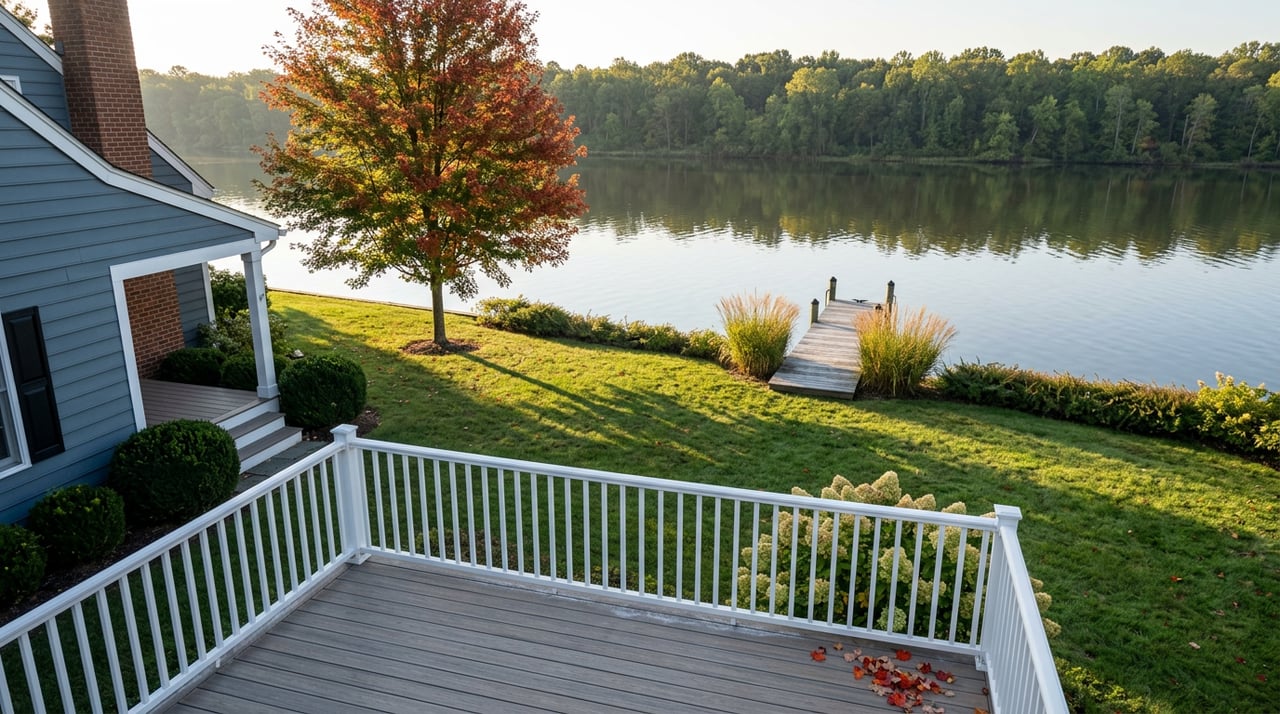
Crystal Lake IL Lake Rights Homes: Which Lake Do They Mean?
September 10, 2026
September 10, 2026
Which lake are you actually buying access to?
That question sounds strange until you spend an afternoon comparing Crystal Lake listings side by side. One home two blocks from downtown advertises proximity to the water but says nothing about access. Another, ten minutes away near Cary schools, promises "lake rights" in bold letters. A third, tucked into a McHenry County subdivision off Ackman Road, lists "Water Rights" as a feature alongside a modest monthly association fee. None of these three homes are describing the same body of water, and the difference matters more than square footage or lot size when you're deciding what you're actually paying for.
Crystal Lake the city has one lake downtown. But "lake rights" as a phrase in local listings can point to that lake, to a completely separate small lake outside city limits, or to nothing at all beyond a marketing flourish. Buyers who assume proximity equals access, or that any home with "lake rights" in the listing means the same lake, are working from the wrong map.
The lake downtown, the one with Main Beach and West Beach, isn't open to anyone who lives nearby. It's managed by the Crystal Lake Park District, and use of it, whether that's launching a kayak, registering a boat, or picking up a key fob for the boat gate, requires residency inside a specific set of boundaries: the City of Crystal Lake, the Village of Lakewood, or unincorporated areas that fall within Crystal Lake Park District lines. That last category catches people off guard. Plenty of addresses with a Crystal Lake mailing address sit outside the park district's actual boundary, which means a house can say "Crystal Lake, IL" on the listing and still not qualify its owner for a lake usage decal.
The park district's current boating rules spell this out plainly: residents of the city, Lakewood, or the district itself may place watercraft on the lake, and everyone else cannot, regardless of how close their backyard sits to the shoreline. Even inside those boundaries, launching isn't universal. Kamijima Park, for instance, is explicitly off limits for watercraft launches. Everything has to go through the Main or West Beach boat gate.
The fee structure for the 2026 season reflects how granular this gets. A resident who wants to put a canoe or paddleboard on the water pays $20 for a non-motorized watercraft decal. Motorized boats scale by horsepower: $50 for anything between 1 and 39 horsepower, $75 for 40 to 99, $125 for 100 to 199, and $200 for 200 horsepower and above. Wanting to launch from the boat gate itself requires a separate key fob, priced at $90 for residents between 18 and 59, and $45 for those 60 and older. None of these fees are optional add-ons for convenience. They're the mechanism that turns "lives near the lake" into "can legally use the lake."
| Access type | Who qualifies | 2026 fee |
|---|---|---|
| Non-motorized watercraft decal | City, Lakewood, or Park District resident | $20 |
| Motorized decal, 1-39 hp | Same residency requirement | $50 |
| Motorized decal, 40-99 hp | Same residency requirement | $75 |
| Motorized decal, 100-199 hp | Same residency requirement | $125 |
| Motorized decal, 200+ hp | Same residency requirement | $200 |
| Boat launch key fob | Same residency requirement | $90 (ages 18-59), $45 (ages 60+) |
If you're evaluating a home based on lake access, the question to ask isn't "how close is it to the water." It's "does this parcel actually sit inside the park district boundary, the city, or Lakewood." A title search or a quick call to the Crystal Lake Park District administrative office answers that faster than any listing description will.
Here's where the confusion compounds. Search for homes near Crystal Lake and you'll run across listings advertising deeded "lake rights" that have nothing to do with the municipal lake at all. A raised ranch that recently came on the market in the Cary school district touted "sought-after lake rights to Lake Killarney," a much smaller lake entirely separate from the one downtown. That's a real, legally attached property right, the kind that transfers with the deed and doesn't depend on where you happen to live relative to a park district line. But it's also a different lake, with its own rules, its own governing association, and none of the downtown beach or boat launch privileges that come with park district residency.
This distinction shows up again in subdivisions like Crystal in the Park, off Ackman west of Randall, where "Water Rights" appears as a listed feature alongside monthly homeowners association dues that run between $4 and $17. That's a genuinely small carrying cost for a deeded amenity, but it's still a cost, and it's still governed by an association rather than by the city's residency rule. Illinois courts have spent decades sorting out exactly what these private lake associations can and can't restrict. The state's leading case on the subject, a 1988 Illinois Supreme Court decision involving Lake Zurich, established that co-owners of a private, non-navigable lake are entitled to reasonable use of the whole surface, but left the harder question of what counts as reasonable to be worked out association by association, subdivision by subdivision.
So when a listing says "lake rights," the honest next question is which lake, and under whose rules. A deeded right to a small private lake with a homeowners association is a fundamentally different asset than residency-based access to the municipal lake with its beaches and boat gates. Both can be worth paying for. They are not the same purchase, and no listing sheet is obligated to spell out the difference for you.
If lake access is part of why you're looking in this area, treat it as a due diligence item, not a given. Before you get attached to a listing that mentions any version of lake access, ask three things: does this parcel sit inside the City of Crystal Lake, the Village of Lakewood, or the park district boundary, or does it just carry a Crystal Lake mailing address. If it references deeded lake rights, which lake, and is there an association governing it, with its own dues and its own rules about docks, boat size, or guest use. And if you're comparing two homes at a similar price where only one advertises lake rights, price that difference against the actual annual cost of the access you'd gain, whether that's a park district decal and key fob or a homeowners association due.
None of this shows up in a median price. It shows up in the fine print of what a specific parcel is entitled to, which is exactly the kind of detail that separates a home that delivers on its lake-adjacent premium from one that only implies it.
Does every home in Crystal Lake, IL have access to the lake? No. Access depends on whether the property sits within the City of Crystal Lake, the Village of Lakewood, or Crystal Lake Park District boundaries. A Crystal Lake mailing address alone doesn't guarantee that.
Is "lake rights" always about the same lake? Not necessarily. Some listings use the phrase to describe deeded access to a separate, smaller private lake, such as Lake Killarney near Cary, which has its own association and rules distinct from the municipal Crystal Lake downtown.
What does it cost to use the municipal lake if I qualify? For the 2026 season, a non-motorized watercraft decal runs $20, motorized decals scale from $50 to $200 by horsepower, and a boat launch key fob costs $90 for residents 18 to 59 or $45 for those 60 and older.
If you're weighing a Crystal Lake purchase and want someone to walk the boundary lines and the deed language with you before you write an offer, the Currey Koertgen Team can help you sort out what a specific address actually entitles you to. And if you're on the seller side wondering what your lake-adjacent home is worth in today's market, that's a conversation worth having too. How much is your home worth?
Whether you're buying, selling, or investing, we’re here to help you navigate the market with confidence. With expert negotiation, strategic marketing, and a client-first approach, we’ll get you the best results.